
Random God Name Generator: Greek, Norse, Egyptian, Hindu & More
Every great story, game, or creative world needs gods with names that carry weight. Whether you’re a Dungeon & Dragons dungeon master building a custom pantheon, a novelist crafting the mythology of a fictional world, a game developer naming the deities in your RPG, or simply someone curious about the names of ancient gods and goddesses across world cultures — finding the right divine name is harder than it sounds. Generic name lists leave you scrolling endlessly. Made-up fantasy names often feel hollow. And copying well-known names like Zeus or Thor into your story creates instant recognition problems.
This random god name generator solves that problem by drawing directly from real mythological traditions. It gives you authentic god and goddess names from eight of the world’s most significant pantheons — Greek, Norse, Egyptian, Hindu, Roman, Celtic, Japanese (Shinto), and Aztec — each result paired with the deity’s domain so you instantly understand what power each name carries. Whether you need a random greek god name generator result for a D&D campaign, a Norse deity for your novel’s religion system, or an Aztec god name for a video game character, this free online deity name generator delivers real names with real mythological weight in seconds.
How the Random God Name Generator Works
The tool is built around two inputs that together give you precise control over which mythological tradition you draw from and how many results appear at once.
Step 1 — Choose Your Mythology Type
The first dropdown is the most important selection in this god name generator. It determines which pantheon — which complete family of gods — your results are drawn from. There are nine options:
Random (All Mythologies) — The default setting. When selected, the generator pulls from the combined pool of all eight mythologies, giving you a genuinely random mix of divine names from across world cultures. This is the best option when you want variety, when you’re building a multicultural fictional world, or when you simply want to discover gods you’ve never heard of. A single generation might surface Anubis (Egyptian), Lugh (Celtic), and Benzaiten (Japanese) side by side.
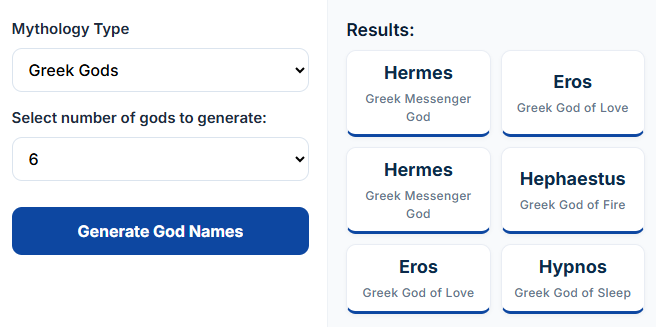
Greek Gods — Draws from the Olympian pantheon and its surrounding mythology. Names like Zeus (God of the Sky), Athena (Goddess of Wisdom), Hades (God of the Underworld), Eros (God of Love), Nemesis (Goddess of Revenge), and Hypnos (God of Sleep). The Greek pantheon is the most extensively documented in Western culture and the most commonly referenced in fantasy and fiction. Each result shows the deity’s name and domain (e.g., “Greek Goddess of Dawn” for Eos).
Norse Gods — Draws from the Aesir and Vanir pantheons of Scandinavian mythology. Names like Odin (All-Father), Thor (God of Thunder), Loki (Trickster God), Freyja (Goddess of Love), Skadi (Goddess of Winter), and Heimdall (Guardian God). Norse mythology is the foundation of much contemporary fantasy — from Marvel’s Thor to nearly all Viking-era worldbuilding — making this one of the most useful categories for creative writers and game designers.
Egyptian Gods — Draws from the ancient Egyptian pantheon spanning thousands of years of recorded worship. Names like Ra (Sun God), Osiris (God of the Afterlife), Anubis (God of Death), Bastet (Cat Goddess), Ma’at (Goddess of Truth), and Thoth (God of Wisdom). Egyptian deity names carry a distinctly exotic phonetic character that makes them exceptionally useful for fantasy worldbuilding when you want divine names that feel genuinely foreign.
Hindu Gods — Draws from the vast Vedic and post-Vedic Hindu pantheon. Names like Brahma (Creator), Vishnu (Preserver), Shiva (Destroyer), Lakshmi (Goddess of Wealth), Ganesha (God of Wisdom), Kali (Goddess of Time), and Hanuman (Monkey God). The Hindu pantheon is one of the largest and most actively worshipped in the world today, with deities spanning every domain of existence. Results include domains like “Hindu God of Compassion” (Krishna) and “Hindu Warrior Goddess” (Durga).
Roman Gods — Draws from the Roman state religion’s pantheon, which heavily mirrors the Greek tradition but with distinct Latin names and slightly different mythological roles. Names like Jupiter (King of Gods), Janus (God of Beginnings), Fortuna (Goddess of Luck), Aurora (Goddess of Dawn), and Vulcan (God of Fire). Roman names often carry a strong, authoritative sound that works well for empire-themed fantasy settings.
Celtic Gods — Draws from the pan-Celtic mythological tradition spanning Ireland, Britain, and Gaul. Names like Dagda (the Good God), Brigid (Goddess of Healing), Lugh (God of Arts), Morrigan (War Goddess), Cernunnos (Horned God), and Manannan (Sea God). Celtic mythology is less widely known than Greek or Norse, making these names particularly useful when you want divine names that feel authentically ancient without being immediately recognizable.
Japanese Gods (Shinto) — Draws from the Shinto kami tradition of Japan. Names like Amaterasu (Sun Goddess), Susanoo (Storm God), Tsukuyomi (Moon God), Raijin (Thunder God), Inari (Rice Goddess), and Benzaiten (Goddess of Flow). Japanese divine names have a distinctive phonetic quality — often flowing, multi-syllabic, and evocative — that makes them stand out in fantasy settings alongside Western mythological names.
Aztec Gods — Draws from the Mesoamerican Aztec religious tradition. Names like Quetzalcoatl (Feathered Serpent), Huitzilopochtli (Sun God), Tlaloc (Rain God), Tezcatlipoca (Smoking Mirror), and Xochiquetzal (Flower Goddess). Aztec deity names are among the most phonetically distinctive of any world mythology — long, complex, and immediately recognizable as Mesoamerican. For fiction and game design, they add immediate geographic and cultural authenticity.
Step 2 — Select Number of Gods to Generate
The second dropdown controls how many deity names appear in each generation. Options are 1, 3, 6, 9, or 12 — with 6 as the default. Each result card shows two pieces of information: the deity’s name in large bold text, and the deity’s domain and pantheon in smaller text below (for example, “Norse God of Thunder” under Thor, or “Egyptian Cat Goddess” under Bastet). This domain label is a key feature — it means you’re not just getting a name, you’re getting instant context about what that deity governs.
Step 3 — Click Generate God Names
Click the Generate God Names button and your results populate the right panel instantly. Every click produces a fresh random selection from your chosen pantheon. There is no limit on generations — click as many times as needed until you find names that fit your creative vision.
What Makes a Great God Name?
Whether you’re looking for authentic historical deity names or inspiration for fictional divine names, the best god names across all cultures share a few consistent qualities.
They carry phonetic weight. Great god names sound powerful when spoken out loud. Compare Quetzalcoatl, Mictlantecuhtli, and Huitzilopochtli — each one demands attention simply through its sound. Even shorter names like Odin, Zeus, and Kali carry authority through their brevity. When choosing a god name for fiction or gaming, say it out loud and notice how it feels.
They signal domain clearly. In most mythological traditions, a god’s name often encoded what they governed — either directly (Helios comes from the Greek word for sun) or through association built over centuries of storytelling. When this tool shows “Greek God of Sleep” under Hypnos, it’s giving you that contextual anchor. For fictional deities, consider building a similar connection between name sound and divine domain.
They fit their cultural context. A Norse god name in a Mediterranean-inspired fantasy world creates instant dissonance. The mythology-type filter in this generator solves this — choose a single pantheon when you need cultural consistency, or use the Random mode when you want deliberate cross-cultural diversity in your fictional world’s religion.
They’re memorable. The gods that have lasted thousands of years in human memory tend to have names that stick — short enough to recall, distinctive enough to not be confused with others. Apollo, Thor, Isis, Ganesha. For fictional deities, the same principle applies.
God Names by Use Case
God Names for D&D and Tabletop RPG Campaigns
Dungeon & Dragons, Pathfinder, and other tabletop RPG systems require dungeon masters to populate their worlds with believable deities. Players will pray to these gods, swear by them, build temples in their honor, and sometimes fight in their name — so the names need to carry real weight. The Random (All Mythologies) mode is ideal here: it generates a diverse mix of real divine names from different traditions that can populate a multi-pantheon fantasy world without feeling invented.
For domain-specific gods — if a player wants to be a cleric of a sea god, a war goddess, or a deity of wisdom — use a specific mythology filter. The domain labels under each name (e.g., “Celtic Sea God” for Manannan, “Egyptian Goddess of Truth” for Ma’at) make it easy to identify deities by their area of power without needing separate research.
God Names for Novel Writing and Fantasy Worldbuilding
When building the religious system of a fictional world, authors face a common tension: invented names feel shallow, but directly using Zeus or Odin creates derivative associations. This random deity generator offers a middle path — authentic mythological names from less-familiar traditions (Celtic, Aztec, Japanese) that most readers won’t immediately recognize, giving your fictional religion genuine depth without the baggage of overused pantheons.
For a secondary-world fantasy novel, the Celtic and Japanese categories are particularly rich sources. Names like Cernunnos, Dagda, Manannan, Amaterasu, and Sarutahiko carry the cadence of real sacred language without the immediate pop-culture associations of Greek or Norse names.
God Names for Video Game Characters
Video game design benefits from god names that are both pronounceable (for voice acting and player communication) and distinctive (for branding and memorability). The Egyptian and Aztec categories produce particularly strong results for games with non-Western settings. Names like Thoth, Sobek, Khepri, Ehecatl, and Tonatiuh carry a visual distinctiveness that works well in character design, trading cards, and game UI.
For games set in a pseudo-historical world — a Viking-era action game or a classical Mediterranean RPG — the Norse and Greek categories produce names that feel authentic to the historical period without requiring research from the player.
God Names for Usernames and Online Profiles
Divine names make powerful, memorable usernames. They’re typically short, phonetically strong, and culturally loaded with power. Names like Ares, Odin, Kali, Loki, Horus, and Nemesis work particularly well as gaming usernames, social media handles, or streaming channel names. The Cool and distinctive options from the Greek and Norse categories especially lend themselves to this use — short, one-word names that are immediately recognizable as mythological.
Baby Names Inspired by Gods and Goddesses
Many divine names from classical mythology have entered mainstream baby naming culture — Luna (Roman Moon Goddess), Aurora (Roman Goddess of Dawn), Diana (Roman Goddess of the Hunt), Iris (Greek Goddess of the Rainbow), and Flora (Roman Goddess of Flowers) are all popular choices. Use the Roman and Greek categories to explore this intersection of mythology and contemporary naming, or browse the Japanese category for more unusual options with beautiful meanings.
God Names for Tattoo Ideas
Mythological deity names are among the most popular tattoo concepts globally — they carry meaning, history, and visual design potential all in one. Names like Anubis, Kali, Fenrir (associated with Norse lore), Medusa (Greek), and Amaterasu inspire entire tattoo concepts beyond just the name itself. Use the generator to explore which deity’s name and domain resonates with something you want to carry permanently.
Mythology Guide: The Eight Pantheons in This Generator
Greek Mythology
The Greek pantheon is the most referenced in Western literary tradition and the foundation of much of European cultural mythology. The twelve Olympians — Zeus, Hera, Poseidon, Demeter, Athena, Apollo, Artemis, Ares, Aphrodite, Hephaestus, Hermes, and Dionysus — form the core, but the Greek divine tradition extends far beyond them to include Titans, primordial deities, and hundreds of minor gods. This generator includes 25 Greek deities, from the major Olympians to lesser-known figures like Hypnos (Sleep), Nemesis (Revenge), and Eos (Dawn).
Norse Mythology
Norse mythology from Scandinavia is one of the richest surviving mythological traditions in the world, documented primarily in the Prose Edda and Poetic Edda from Iceland. The Norse pantheon divides into the Aesir (warrior gods, including Odin and Thor) and the Vanir (fertility gods, including Freyja and Freyr). This generator includes 25 Norse deities — from the familiar (Odin, Thor, Loki) to the less-known (Forseti, God of Justice; Eir, Goddess of Healing; Ullr, God of Hunting).
Egyptian Mythology
Ancient Egyptian mythology spans over 3,000 years of continuous religious tradition — one of the longest in human history. Egyptian gods were often depicted with animal heads reflecting their divine domains: Anubis with the head of a jackal, Bastet with the head of a cat, Sobek with the head of a crocodile. This generator includes 25 Egyptian deities, covering the major gods of the classic period (Ra, Osiris, Isis, Horus) as well as specialist deities like Bes (Protector God) and Ma’at (Goddess of Truth and Justice).
Hindu Mythology
The Hindu pantheon is unique among world mythologies in that it remains an active living religious tradition with over a billion followers worldwide. Hindu deities span creation (Brahma), preservation (Vishnu), and destruction (Shiva) as the Trimurti — the triple aspect of the divine — along with an enormous supporting cast of gods, goddesses, and divine beings. This generator includes 25 Hindu deities, from the Trimurti to the Navagraha planetary deities (Surya, Chandra, Mangala, Shani) and warrior goddesses like Durga and Kali.
Roman Mythology
Roman mythology drew heavily from Greek tradition, adopting many Greek gods under Latin names while reshaping their mythology to reflect Roman values — military virtue, civic order, and imperial destiny. Jupiter (Zeus), Mars (Ares), and Venus (Aphrodite) are the most prominent, but Roman mythology also includes distinctly Roman deities like Janus (God of Beginnings and Doorways, unique to Rome) and Vesta (Goddess of the Hearth). This generator includes 25 Roman deities including several without direct Greek equivalents.
Celtic Mythology
Celtic mythology spans multiple cultures across Ireland, Wales, Scotland, and ancient Gaul (modern France), with traditions preserved in medieval Irish and Welsh manuscripts. The Irish Tuatha Dé Danann — the divine race including Dagda, Brigid, and Lugh — form the core of Irish Celtic mythology, while Gaulish deities like Cernunnos and Epona represent the continental tradition. This generator includes 25 Celtic deities, many of whom are rarely encountered in mainstream mythology references.
Japanese (Shinto) Mythology
Shinto, Japan’s indigenous religion, features a vast pantheon of kami — divine spirits inhabiting natural phenomena, places, and ancestral forces. The creation deities Izanagi and Izanami formed the world; their children include Amaterasu (Sun Goddess), Susanoo (Storm God), and Tsukuyomi (Moon God) — the three most important kami in Shinto. This generator also includes the Seven Lucky Gods (Shichifukujin) — Benzaiten, Bishamonten, Daikokuten, Ebisu, Fukurokuju, Jurojin, and Hotei — a popular grouping in Japanese religious folk culture.
Aztec Mythology
Aztec mythology from Mesoamerica is one of the world’s most dramatic and complex divine traditions — featuring multiple creation cycles (the Five Suns), gods who sacrifice themselves to create the world, and a cosmic order that requires ongoing ritual maintenance. Aztec deity names are phonetically distinctive and immediately recognizable as Mesoamerican. This generator includes 25 Aztec deities, from the major cosmic gods (Huitzilopochtli, Quetzalcoatl, Tezcatlipoca) to specialist deities like Tlaloc (Rain God), Mixcoatl (Hunting God), and Xilonen (Young Maize Goddess).
Real-Life Usage Examples
Example 1: Building a D&D Pantheon
Situation: A dungeon master is building a homebrew campaign set in a world with five active religious cults, each worshipping a different domain deity. They need names for gods of war, wisdom, death, nature, and the sea.
Tool settings: Mythology → Random | Count → 12
Sample results: Thor (Norse, Thunder), Athena (Greek, Wisdom), Anubis (Egyptian, Death), Manannan (Celtic, Sea), Cernunnos (Celtic, Nature), Fortuna (Roman, Luck), Kali (Hindu, Time), Susanoo (Japanese, Storm), Tlaloc (Aztec, Rain), Nemesis (Greek, Revenge), Brigid (Celtic, Healing), Varuna (Hindu, Oceans)
How to use it: From this set, a dungeon master could assign Anubis as the God of Death, Athena as the God of Wisdom, Manannan as the God of the Sea, Cernunnos as the God of Nature, and Thor as the God of War — five distinct names from five different mythological traditions, each with an established divine domain that gives players instant orientation. The domain labels make this selection process take minutes rather than hours of research.
Example 2: Naming a Fictional World’s Religion (Novel Writing)
Situation: A fantasy author is writing a novel set in a Mediterranean-inspired world but wants the religious tradition to feel unfamiliar enough that readers don’t project Greek mythology onto it. They want divine names that feel ancient and authentic without being immediately recognized.
Tool settings: Mythology → Celtic | Count → 6
Sample results: Dagda (Good God), Brigid (Goddess of Healing), Lugh (God of Arts), Morrigan (War Goddess), Cernunnos (Horned God), Rosmerta (Goddess of Fertility)
How to use it: These six names form an immediately coherent fictional pantheon. Most readers won’t recognize Rosmerta or Dagda the way they’d recognize Zeus or Apollo, but the names carry genuine mythological weight and phonetic authenticity. The author can use these as direct names or as inspiration — Morrigan’s identity as a war goddess with a dark, sinister-sounding name immediately suggests character design for a deity of conflict.
Example 3: Gaming Username from Mythology
Situation: A competitive gamer wants a new username that sounds powerful and mythological but isn’t overused (no Thor, Zeus, or Odin — everyone has those).
Tool settings: Mythology → Egyptian | Count → 9
Sample results: Thoth (God of Wisdom), Sobek (Crocodile God), Khepri (Scarab God), Atum (Creator God), Tefnut (Goddess of Rain), Shu (God of Air), Geb (Earth God), Bes (Protector God), Khonsu (Moon God)
How to use it: Thoth, Sobek, and Khonsu are all genuinely powerful-sounding names that are rarely used as gaming handles because Egyptian mythology is less commonly referenced in gaming culture than Norse or Greek. Sobek in particular — short, hard-consonant, visually distinctive — makes an excellent competitive gaming username with a god’s authority behind it.
Example 4: Cross-Cultural Random Discovery
Situation: A mythology enthusiast wants to explore gods they’ve never encountered before — deliberately avoiding the well-known Greek and Norse pantheons.
Tool settings: Mythology → Random | Count → 12
Sample results might include: Nodens (Celtic God of Healing), Huixtocihuatl (Aztec Salt Goddess), Sarutahiko (Japanese Guidance God), Forseti (Norse God of Justice), Chantico (Aztec Hearth Goddess), Sirona (Celtic Healing Goddess), Konohanasakuya (Japanese Blossom Goddess), Itzpapalotl (Aztec Obsidian Goddess), Eir (Norse Goddess of Healing), Nantosuelta (Celtic Goddess of Nature), Omoikane (Japanese Wisdom God), Bormana (Celtic Spring Goddess)
How to use it: Nearly every name in this batch is a deity that most people — even mythology enthusiasts — will be unfamiliar with. This is the generator’s deepest value: surfacing the less-documented corners of world mythology. Itzpapalotl (Aztec Obsidian Butterfly Goddess) and Konohanasakuya (Japanese Blossom Goddess) are genuinely fascinating divine figures with rich mythological stories that most discovery tools would never surface.
Frequently Asked Questions
Q1: What are some cool god names for a character or username? For short, powerful god names that work as usernames or character names, the best options are often one-syllable Greek names (Ares, Zeus) or two-syllable Norse names (Odin, Loki, Baldr). For something less common, Egyptian names like Thoth, Sobek, or Shu are short, powerful, and rarely used as handles. Japanese names like Raijin and Fujin are distinctive and memorable. Generate a batch of 9 using the Greek, Norse, or Egyptian filter and scan for the names that feel right for your context.
Q2: How do I come up with a god name for my story or fictional world? Use the generator in Random mode to get a broad cross-cultural mix, then identify which names and domains fit the divine roles your story needs. The domain labels (e.g., “Aztec Rain God” for Tlaloc, “Celtic War Goddess” for Morrigan) make it easy to match names to narrative functions. For less familiar-feeling names, the Celtic and Aztec categories produce results that most readers won’t immediately associate with a specific real-world mythology.
Q3: What are the names of all the Greek gods in this generator? This generator includes 25 Greek deities: Zeus (Sky), Hera (Queen of Gods), Poseidon (Sea), Demeter (Harvest), Athena (Wisdom), Apollo (Music & Light), Artemis (Hunt), Ares (War), Aphrodite (Love), Hephaestus (Fire), Hermes (Messenger), Dionysus (Wine), Hades (Underworld), Persephone (Queen of Underworld), Eros (Love), Hebe (Youth), Helios (Sun), Selene (Moon), Eos (Dawn), Nike (Victory), Hypnos (Sleep), Thanatos (Death), Iris (Rainbow), Pan (Wild), and Nemesis (Revenge).
Q4: Can I use this as a random goddess name generator specifically? Yes. While the generator doesn’t filter exclusively by gender, every mythology in the tool includes prominent goddesses. The Greek category includes Hera, Athena, Artemis, Aphrodite, Demeter, Persephone, Hebe, Selene, Eos, Nike, and Iris. The Norse category includes Freyja, Skadi, Frigg, Idun, Sif, Gefjon, Hel, and the Valkyries. Generate multiple rounds within any mythology and you’ll regularly surface goddess names alongside god names.
Q5: What are some powerful-sounding god names? Power in a deity name typically comes from either phonetic weight (hard consonants, strong vowels) or mythological gravitas. Phonetically powerful options from this generator include: Tezcatlipoca and Huitzilopochtli (Aztec), Cernunnos and Morrigan (Celtic), Takemikazuchi (Japanese), Sekhmet and Thoth (Egyptian), Odin and Heimdall (Norse). For maximum authority, the Aztec and Egyptian categories consistently produce the most phonetically imposing results.
Q6: Is this useful for D&D deity names specifically? Absolutely. The Random mode across all eight mythologies produces exactly the kind of pantheon diversity that D&D homebrew worlds need. The domain labels on each card (e.g., “Norse God of Justice” for Forseti, “Celtic God of Eloquence” for Ogmios) make it easy to assign deities to specific cleric domains, paladin oaths, and divine portfolios without needing to research each name separately. Generate 12 names in Random mode for a full homebrew pantheon in under a minute.
Q7: Can I use these names for a fantasy novel or game without copyright issues? Yes. All names in this generator are drawn from historical mythologies and are part of the public domain. Zeus, Odin, Anubis, Shiva, and every other deity in this tool have been in the public domain for centuries — they are historical religious figures, not proprietary intellectual property. You are free to use any name generated here in your novel, game, tabletop campaign, or other creative work.
Q8: What is the difference between Greek and Roman gods in this generator? The Roman pantheon largely parallels the Greek one, with Latin names replacing Greek names (Jupiter = Zeus, Mars = Ares, Venus = Aphrodite, Neptune = Poseidon, Mercury = Hermes, Diana = Artemis, Minerva = Athena). However, several Roman deities are unique — Janus (God of Beginnings and Doorways), Vesta (Goddess of the Hearth), Fortuna (Goddess of Luck), and Quirinus (Roman War God) have no direct Greek equivalents. The generator includes these uniquely Roman figures in the Roman category.
Pro Tips for Getting the Most from This God Name Generator
Use domain labels as your primary filter. When you need a deity for a specific role — war, wisdom, death, sea, harvest — don’t scan for the name first. Read the domain label under each generated name and find the functional match. The tool surfaces the name and domain together precisely for this reason.
Generate in batches of 9 or 12 for worldbuilding. A full fantasy religion needs multiple deities, not just one. Generate 12 names in Random mode and you’ll often have an entire pantheon ready in a single click — covering multiple domains from multiple cultural traditions.
Use less familiar mythologies for more original results. Greek and Norse names are overrepresented in fantasy media. If your story, game, or character needs to feel genuinely original, lean into the Celtic, Aztec, and Japanese categories — traditions that are deeply rich but far less commonly referenced in mainstream fiction and games.
Combine the domain label with the name for richer worldbuilding. When you generate Forseti (Norse God of Justice), that domain label isn’t just context — it’s a creative brief. A god of justice in a Norse-inspired world would have specific iconography, ritual practices, and narrative roles. Let the domain drive the creative work, not just the name.
For gaming usernames, try Egyptian and Japanese first. Greek and Norse god names are heavily used as gaming handles. The Egyptian and Japanese categories produce equally powerful names that are far less common in gaming communities — Thoth, Sobek, Raijin, Susanoo, and Takemikazuchi all make memorable handles that stand out.
Cross-reference with mythology sources after generating. This tool gives you the name and domain — but each deity has a full mythological story behind them. Once you’ve found a name that resonates, look up the deity’s myths. Knowing that Morrigan is a shapeshifting crow-goddess of war and fate in Irish mythology adds enormous depth to using her name in fiction or a campaign.
Related Tools You May Like
- Random Username
- Cute Nickname Generator
- God Name Generator
- Hero Name Generator
- Middle Name Generator
- Random Last Names
- Random Name Wheel
- Random Japanese Name
- Random Identity
- Random Nickname
- Random Cat Name
- Random Dog Name
Additional Resources
- Encyclopedia Britannica — World Mythology – Authoritative source for mythological accuracy, pantheon descriptions, deity domains, and cultural context across all eight mythologies in the tool
- Theoi Greek Mythology Project – The most comprehensive English-language database of Greek mythological figures — ideal reference for the Greek pantheon section and FAQ answers about Greek gods