
Random Facts Generator – Discover Interesting Facts
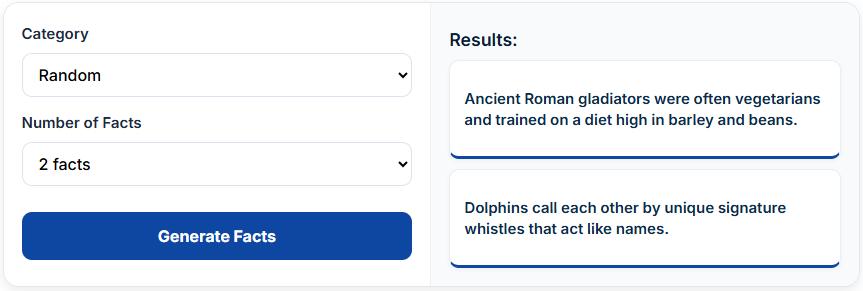
Want to discover something interesting and learn something new? Our Random Facts Generator is a simple way to explore interesting facts and discover information about different subjects. Enter a topic in the search field and use the Search button to explore facts related to your chosen subject.
Whether you enjoy science, history, animals, nature, technology, or everyday knowledge, discovering new information can make learning more enjoyable. Use this tool as a starting point for exploring topics that catch your attention.
What Is a Random Facts Generator?
A random facts generator is an online tool designed to help users discover interesting information. It can make everyday learning more engaging by giving you a way to explore subjects you might not normally search for.
People enjoy random facts because they can introduce unfamiliar ideas, explain unusual details, and encourage curiosity. A short fact about an animal, historical event, scientific discovery, or everyday object can lead to a much deeper exploration of that subject.
This tool provides a search field where you can enter a topic and click Search. It offers a straightforward starting point for exploring facts about different topics.
How to Use the Random Facts Generator
Getting started is simple:
- Enter a Topic: Type a subject or keyword into the input field. For example, you can enter a topic such as animals, space, history, or science.
- Click Search: Select the Search button to submit your topic.
- Explore the Information: Review the information presented by the tool and explore anything that catches your interest.
- Try Another Topic: Change your search term to discover information about a different subject.
Experimenting with different keywords can help you explore a wider range of interesting information.
Popular Topics for Discovering Interesting Facts
There are countless subjects worth exploring. Here are some broad topic ideas that can help you get started.
Science and Space
Science explains how the natural world works, from tiny particles to enormous galaxies. Exploring science facts can introduce you to subjects such as physics, chemistry, astronomy, and the human body.
You might explore planets, stars, scientific discoveries, natural forces, or the technology used to study the universe.
Animals and Nature
The natural world is full of fascinating details. Exploring animal facts and nature facts can help you learn about different species, habitats, ecosystems, and the ways living things adapt to their environments.
You can search for subjects such as ocean animals, birds, insects, forests, or wildlife.
For more animal-related exploration, visit our Random Animal Generator.
History and Culture
History offers an opportunity to explore past civilizations, important events, inventions, traditions, and influential developments.
Looking for historical facts can help you understand how societies changed over time and how earlier events shaped the modern world.
You might explore ancient civilizations, historical discoveries, famous landmarks, or the origins of everyday traditions.
Technology and Inventions
Technology has changed how people communicate, travel, work, and learn. Exploring technology facts can introduce you to computers, the internet, engineering, inventions, and scientific innovations.
You can start with a familiar subject and then explore related developments that interest you.
Everyday Life
Some of the most enjoyable fun facts are connected to ordinary things. Food, household objects, language, transportation, and daily habits all have interesting histories and explanations.
Try entering a familiar everyday topic and see what new questions it inspires.
Why Do People Enjoy Random Facts?
Discovering new information can be entertaining as well as educational. Fascinating facts give people small opportunities to explore unfamiliar subjects without committing to a long lesson.
Here are some reasons people enjoy discovering facts:
- Curiosity: Interesting information can encourage you to investigate a subject further.
- Learning: Short pieces of information can introduce new ideas and useful background knowledge.
- Conversation: A surprising fact can become an interesting topic to discuss with friends or classmates.
- Education: Exploring different subjects can support general knowledge and learning activities.
- Entertainment: Unusual information can make a break or free moment more enjoyable.
- Inspiration: A small discovery may encourage you to read more about science, history, nature, or another subject.
A fact can be more than an interesting detail. It can also be the beginning of a new question or learning experience.
How to Find Reliable and Accurate Facts
Not everything described as a fact online is necessarily accurate. When exploring factual information, it is important to consider where a claim comes from and whether reliable evidence supports it.
Use these simple habits when researching something interesting:
Check the Original Source
Look for the original research, official record, educational resource, or publication behind a claim whenever possible.
Compare Reliable Sources
Do not rely entirely on a single website for an unusual or surprising claim. Comparing information from more than one trustworthy source can help you identify errors or missing context.
Consider the Date
Some information changes over time. Statistics, scientific discoveries, technology, and current events may require more recent sources than established historical information.
Understand the Context
A statement can be technically accurate but misleading when important details are missing. Read the surrounding explanation and consider what the information actually describes.
For more guidance, explore the National Geographic Education guide to news literacy, which explains how to distinguish facts from opinions and evaluate information sources.
You can also read Purdue University’s guide to evaluating information sources for advice on checking evidence, cross-referencing claims, and assessing the reliability of information.
Ways to Use Interesting Facts
Random interesting facts can be useful in many everyday situations. You can explore information for personal enjoyment or use it as inspiration for activities.
- Classroom activities: Find a topic that can introduce a lesson or encourage students to ask questions.
- Conversation starters: Share a verified discovery to begin an interesting discussion.
- Creative writing: Use factual information as background inspiration for stories and other creative projects.
- Quizzes and games: Research facts that can be turned into questions for a learning activity.
- Personal learning: Explore subjects that you have always wanted to understand better.
- Social content: Use verified information as inspiration for educational posts, making sure to check the original source before publishing.
If you enjoy question-based activities, try our Random Trivia Questions Generator. You can also explore the Random Questions Generator for more conversation and activity ideas.
Explore More Random Fun and Fantasy Tools
Learning and entertainment can go together. RandomNamePick offers several tools for exploring different subjects and discovering new ideas.
Try the Random Topics Generator to find subjects for discussions, writing exercises, and other activities.
If you prefer discovering individual objects or things, explore our Random Object Generator and Random Thing Generator.
These tools offer different ways to find inspiration and explore ideas when you are not sure what to choose next.
Frequently Asked Questions
1. What is a Random Facts Generator?
A Random Facts Generator is an online tool for exploring interesting information about different subjects. It gives users a simple way to enter a topic and discover information related to it.
2. How do I use the Random Facts Generator?
Enter a topic or keyword in the input field and click the Search button. You can try different subjects to explore more information.
3. What topics can I search for?
You can try broad subjects such as science, animals, history, nature, space, technology, food, or everyday life. The topics you explore depend on the search terms you enter.
4. Are random facts useful for learning?
Yes. Educational facts can introduce unfamiliar subjects and encourage further research. For a better understanding, explore the original sources and read additional information about the topic.
5. Can I use interesting facts for classroom activities?
Interesting information can be used as inspiration for classroom discussions, research exercises, and learning activities. Teachers and students should verify important claims using reliable references.
6. How can I check whether a fact is true?
Look for the original source, compare the claim with other reliable publications, check the date, and read the surrounding context. University, government, and established educational resources can be useful starting points.
7. What is the difference between a fact and an opinion?
A fact is a statement that can be checked against evidence. An opinion expresses someone’s personal belief, feeling, or judgment. Learning to distinguish between them helps you evaluate information more carefully.
8. Can I use facts in quizzes and social media posts?
Yes. Verified facts can provide inspiration for quizzes, educational posts, and conversations. Always check the accuracy and context of a claim before sharing or publishing it.