
Random Fun Facts Generator – Interesting and Surprising Facts
The Random Fun Facts Generator helps you discover entertaining pieces of information without having to search through long lists or decide what to read next. Choose a category, select a fact type, and generate a collection of random fun facts for a quick dose of curiosity.
Looking for random fun facts to brighten your day? Our collection has something for everyone, from random fun facts of the day to random fun facts most people don’t know. Whether you need random fun facts to share at work to break the ice with colleagues, or random fun facts to share about yourself in a conversation, you’ll find plenty here. Explore random fun facts about the human body, random fun facts about the world, and even random fun facts about a person that will surprise you. We also have random fun facts no one knows for curious minds, plus simple and safe random fun facts for kids to enjoy and learn from.
From unusual details about the natural world to unexpected bits of everyday knowledge, fun facts can make conversations more interesting, add variety to classroom activities, and give you something surprising to share. Use this tool whenever you want interesting fun facts, a conversation starter, or a little entertainment.
How to Use the Random Fun Facts Generator
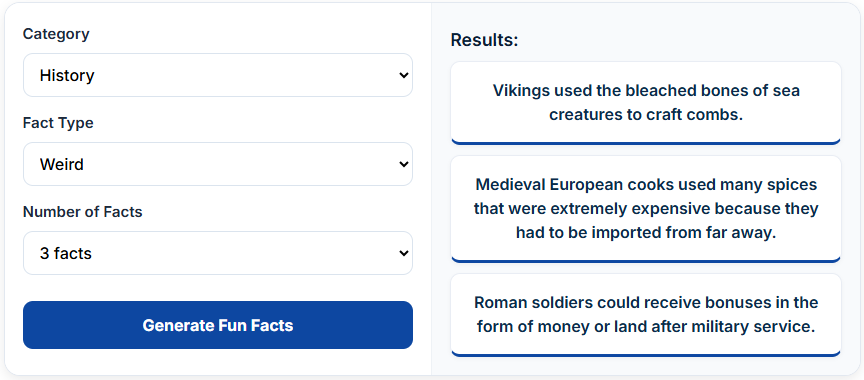
The generator has a small set of selection controls designed to help you choose the kind of facts you want to explore.
- Choose a Category: Select a category from the Category dropdown to guide the subject of the generated facts.
- Select a Fact Type: Use the Fact Type dropdown to choose the available type of fun fact.
- Choose the Number of Facts: Set how many results you want using the Number of Facts dropdown.
- Generate Your Results: Click Generate Fun Facts to display the results in the Results section.
You can adjust the selections and generate another set whenever you want to explore a different combination. The exact options depend on the choices currently available in the tool.
What Makes a Fact Fun and Interesting?
A fun fact is a short piece of information that catches someone’s attention because it is unusual, unexpected, amusing, or simply unfamiliar. It can be about science, nature, history, animals, technology, culture, or everyday life.
Unlike a detailed research article, a bite-sized fact communicates one main idea quickly. The best examples are easy to understand and memorable enough to share with someone else.
Common qualities of interesting facts include:
- Surprise: The information challenges an assumption or reveals something unexpected.
- Curiosity: It encourages readers to ask another question or explore a subject further.
- Simplicity: The main idea can be understood without a lengthy explanation.
- Relevance: It connects to something people recognize, experience, or want to learn about.
- Verifiability: A factual claim can be checked against reliable evidence.
A surprising statement is not automatically true. When a fact seems extraordinary, checking its original source and context helps separate genuine discoveries from exaggerated claims.
Explore Different Types of Random Fun Facts
Fun facts can cover almost any subject. The categories and fact types available in the generator determine the selections you can make, while the following themes illustrate the kinds of topics people often enjoy exploring.
Nature and Animal Facts
The natural world is full of unusual behaviors, adaptations, and environmental relationships. Animal fun facts can introduce readers to different species, habitats, and survival strategies.
For more wildlife discovery, try the Random Animal Generator. You can also explore specific bird species with the Random Bird Generator or discover aquatic life through the Random Fish Generator.
Science and Space Facts
Science-related facts can make complex ideas easier to approach. Topics such as space, weather, physics, and the human body often provide excellent surprising facts because they reveal how familiar things work.
Use an interesting discovery as a starting point, then look for a trustworthy scientific explanation if you want to understand the subject in more depth.
History and Culture Facts
Historical and cultural facts can introduce unfamiliar events, traditions, inventions, and everyday practices from different periods and places. These little-known facts can make history feel more approachable and encourage further reading.
Remember that historical details sometimes depend on dates, locations, and interpretation. Check the context before repeating a claim as definitive.
Technology and Everyday Life Facts
Technology and ordinary routines can also produce fascinating discoveries. A small detail about communication, transportation, household objects, or digital tools can change how you think about something familiar.
These cool fun facts are particularly useful for casual conversations because they connect to experiences people already understand.
Creative Ways to Use Fun Facts
A random fact can be more than something to read and forget. It can become the starting point for an activity, discussion, or creative idea.
- Conversation starters: Share an unusual fact with friends, family, or colleagues to begin an interesting discussion.
- Classroom warm-ups: Teachers can use a short fact to introduce a lesson or encourage students to ask questions.
- Social media content: Turn a verified fact into a short educational post, caption, or discussion prompt.
- Quiz preparation: Use a fact as inspiration for a question, then create answer choices and check the correct response.
- Writing inspiration: A surprising detail can become the opening idea for a story, article, or creative exercise.
- Family activities: Take turns reading facts and asking each other to explain why they might be true.
- Personal learning: Explore a subject you do not usually read about and follow up on the details that interest you.
If you want to turn discoveries into a quiz, visit the Random Trivia Questions Generator. For open-ended discussion, the Random Questions Generator can provide a different kind of prompt. You can also use the Random Topics Generator to find a subject for further conversation or writing.
How to Check Whether a Fun Fact Is Reliable
Some online posts use dramatic wording to make ordinary claims seem extraordinary. Before sharing a surprising fact, take a moment to check whether it is supported by evidence.
A useful fact-checking routine is:
- Find the original source: Look for the research, official record, expert explanation, or publication behind the claim.
- Check the context: Make sure the fact has not been shortened in a way that changes its meaning.
- Compare reliable sources: See whether independent, credible sources support the same information.
- Check the date: Scientific findings, statistics, and current information may change over time.
- Separate fact from opinion: A personal interpretation or amusing description is not necessarily an objective fact.
National Geographic’s news literacy resource explains how to distinguish facts from opinions and evaluate information sources. The Purdue OWL guide to evaluating sources also covers evidence, source credibility, and cross-checking.
These habits are especially useful when sharing weird fun facts, statistics, or claims that sound almost too surprising to be true.
Random Fun Facts vs. Random Facts and Trivia Questions
These related formats serve different purposes, so choosing the right one makes your search more useful.
- Random fun facts: Short, entertaining information intended to surprise or amuse.
- General random facts: Broader factual information that may be used for learning or exploring a subject.
- Trivia questions: Questions designed to test what someone knows or encourage them to guess an answer.
- Random questions: Open-ended prompts for conversation, reflection, or discussion.
- Random topics: Subjects that can be developed into a conversation, research task, or writing activity.
If you want broader factual discovery rather than entertainment-focused selections, use the Random Facts Generator. For a more imaginative activity, the Random Monster Generator and Random Object Generator offer different kinds of creative inspiration. You can also explore the Random Thing Generator for general random ideas.
Who Can Benefit from a Fun Facts Generator?
The tool can be useful for anyone looking for a quick source of entertainment or a starting point for an activity.
- Students: Discover unfamiliar subjects and find ideas for classroom discussions.
- Teachers: Add short curiosity-building activities to lessons.
- Parents and families: Make learning together more playful with quick facts and follow-up questions.
- Content creators: Find inspiration for short-form educational or entertainment content, while verifying claims before publishing.
- Quiz hosts: Collect ideas that can be developed into trivia rounds.
- Curious readers: Explore subjects they might not normally search for.
The generator is intended for discovery and inspiration. It should not replace source checking when you need accurate information for academic, professional, or public use.
Tips for Getting More from the Generator
- Try different available categories instead of staying with one subject.
- Change the fact type to explore another style of result.
- Select a manageable number of facts so you can read and consider each one.
- Keep a note of facts that inspire a question or a new topic.
- Verify important claims before using them in schoolwork, presentations, or public posts.
- Turn a fact into a follow-up question to make the activity more interactive.
Frequently Asked Questions
1. What is a Random Fun Facts Generator?
A Random Fun Facts Generator is an online tool that produces entertaining and interesting fact selections. This generator lets you choose a category, select a fact type, and choose the number of facts before generating results.
2. How do I generate random fun facts?
Choose an option from the Category dropdown, select a Fact Type, choose the Number of Facts, and click Generate Fun Facts. The generated results appear in the Results section.
3. What types of facts can I discover?
The tool provides Category and Fact Type selectors. The exact choices depend on the options currently available in those dropdowns. Fun facts in general can cover subjects such as animals, nature, science, history, technology, and everyday life.
4. Can I use fun facts for classroom activities?
Yes. Teachers can use suitable facts as lesson introductions, discussion starters, research prompts, or short learning activities. Students should verify important information before including it in assignments.
5. Are random fun facts always accurate?
Not necessarily. A generated result should not be treated as verified simply because it appears in a generator. Check surprising or important claims against reliable sources, especially before sharing them publicly.
6. What is the difference between fun facts and trivia questions?
Fun facts present interesting information for readers to discover. Trivia questions ask people to recall or guess information, usually with the aim of testing knowledge or playing a quiz.
7. Can I use generated facts for social media posts?
You can use them as inspiration for social media content, but verify each claim and check its context first. Add your own explanation or a reliable source when appropriate.
Discover Something Interesting
Use the Random Fun Facts Generator to explore entertaining information, find a new conversation starter, or get inspiration for a quick activity. Choose your preferred category and fact type, select the number of results, and see what interesting discoveries appear.