
Random Topics Generator – Find Speaking, Writing, and Research Ideas
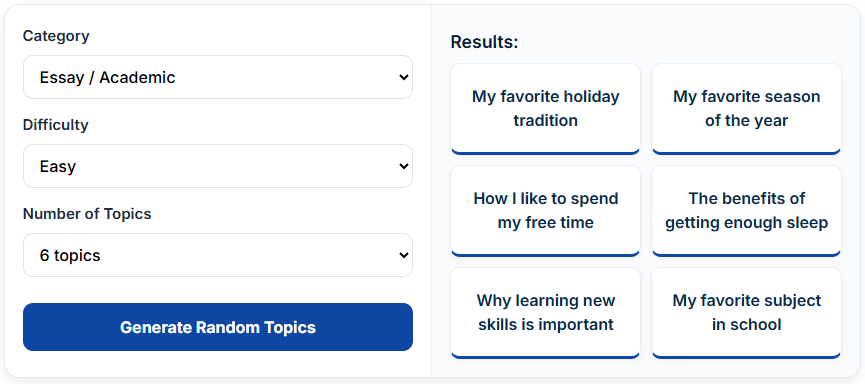
Need an interesting subject for a speech, conversation, essay, or research project? The Random Topics Generator helps you discover fresh ideas without spending time brainstorming from scratch. Choose a category, select a difficulty level, decide how many topics you need, and click Generate Random Topics.
Whether you need random topics for speaking, interesting things to discuss with friends, subjects to research for fun, or ideas for your next essay, this tool provides a convenient starting point. Use the generated topics for classroom activities, public speaking practice, creative writing, and everyday learning.
What Is a Random Topics Generator?
A Random Topics Generator is an online tool that provides topic ideas for different activities. Instead of repeatedly searching for something interesting to discuss or write about, you can generate a selection and choose the subject that best matches your purpose.
A topic is a subject or central idea that you can explore through conversation, research, writing, or a presentation.
For example, a topic such as “The Future of Artificial Intelligence” could become:
- A one-minute classroom speech.
- A longer informative presentation.
- A research project about technology.
- A debate about the benefits and risks of AI.
- A discussion about how technology affects everyday life.
The same subject can support different activities depending on the questions you ask and the information you want to explore.
This generator includes Category, Difficulty, and Number of Topics selections, allowing you to customize your topic generation before viewing the results.
How to Use the Random Topics Generator
The tool has three selection fields and a generation button.
Follow these steps:
- Choose a Category: Select an available category from the Category dropdown.
- Select Difficulty: Choose an appropriate difficulty level using the Difficulty dropdown.
- Choose Number of Topics: Set how many topics you want to generate.
- Generate Topics: Click the Generate Random Topics button.
- Review Results: Explore the generated topics in the Results section.
- Generate Again: Adjust your selections and create another list when you need more ideas.
The available choices depend on the options displayed in the live tool.
A useful approach is to select a topic that matches your intended activity. A simple subject might be suitable for a one-minute speech, while a more complex subject could work better for an essay or research project.
Random Topics for Speaking
Finding something interesting to talk about is not always easy, especially when you have limited preparation time.
Random topics for speaking can help students, English learners, and public speakers practise organizing their thoughts and expressing ideas clearly.
Here are some examples of speaking topics:
Topic | Suggested discussion angle |
The Importance of Education | How does education influence opportunities? |
Social Media and Society | Does social media bring people closer together? |
The Future of Technology | Which technologies could change everyday life? |
The Value of Friendship | What makes a friendship meaningful? |
Environmental Protection | What can individuals do to protect nature? |
Learning from Mistakes | Why are mistakes important for personal growth? |
The Role of Sports | How can sports influence physical and mental development? |
Online Learning | Is online education as effective as traditional learning? |
Artificial Intelligence | How might AI change future careers? |
The Importance of Reading | How does reading influence knowledge and imagination? |
These are illustrative examples, not confirmed outputs from the generator.
Random Topics to Talk About for 1 Minute
A one-minute speech should focus on one clear idea rather than attempting to explain an entire subject.
If you are searching for random topics to talk about for 1 minute, start with familiar subjects that you can explain using personal experiences or simple examples.
Here are 15 ideas:
- My favorite childhood memory.
- A skill everyone should learn.
- Why kindness matters.
- My favorite place to visit.
- The importance of good habits.
- A person who inspires me.
- Why exercise is important.
- My dream vacation.
- The best invention in history.
- One thing I would change about my school.
- The value of time.
- Why teamwork matters.
- A book that changed my perspective.
- My favorite way to spend a weekend.
- What makes someone a good friend?
A simple one-minute speaking structure:
- First 10 seconds: Introduce the topic.
- Next 35 seconds: Explain your main idea and give an example.
- Final 15 seconds: Summarize your point.
For example, if your topic is “The Value of Time,” explain why time is important, share an everyday example, and finish with one practical lesson.
The University of Maine Cooperative Extension provides an impromptu public speaking exercise in which participants draw a random topic and prepare a short presentation. It is a useful reference for practising quick thinking and speaking.
Random Topics for Public Speaking and Speeches
A random topic generator for public speaking can help students and speakers practise presenting ideas without knowing the subject in advance.
This type of practice is often called impromptu speaking. The speaker receives a topic, thinks about it briefly, organizes a few points, and presents an explanation or opinion.
Impromptu Speech Topics
Impromptu speeches are usually based on subjects that a speaker can discuss using general knowledge, personal experience, or a reasoned opinion.
Examples include:
- Should students have less homework?
- Is technology making people more productive?
- Why is communication important?
- Should everyone learn a second language?
- Is online education the future?
- What makes a successful leader?
- Should schools teach financial literacy?
- Is teamwork more important than individual talent?
Informative Speech Topics
An informative speech explains a subject and helps an audience understand it.
Some possible topics are:
- How renewable energy works.
- The history of the internet.
- How the human brain processes information.
- The importance of biodiversity.
- How artificial intelligence is developed.
- The science behind sleep.
- How recycling systems work.
- The development of space exploration.
Persuasive Speech Topics
A persuasive speech aims to influence an audience’s opinions or encourage a particular action.
Consider these examples:
- Why schools should encourage physical activity.
- Should public transportation be improved?
- Why protecting the environment should be a priority.
- Should students learn practical financial skills?
- Is reading more beneficial than watching television?
- Should communities invest more in public parks?
When choosing a public speaking topic, consider your audience, the purpose of the presentation, and the amount of time available.
The University of Tennessee’s Public Speaking Center provides impromptu speech topics and classroom activities that can help students practise presenting ideas.
Random Topics to Talk About With Friends
Sometimes conversations become repetitive because everyone discusses the same subjects. Trying a new topic can make a conversation more interesting.
Random topics to talk about with friends can include personal experiences, funny situations, opinions, hobbies, memories, and hypothetical questions.
Here are some conversation topics:
Fun and Lighthearted Topics
- What would you do if you could become invisible for one day?
- Which fictional character would make the best roommate?
- What is the funniest thing that happened to you recently?
- If you could invent a new holiday, what would it celebrate?
- What unusual food combination would you try?
Interesting Discussion Topics
- What makes a person genuinely successful?
- Is travelling more valuable than buying expensive things?
- Can technology replace human creativity?
- What is one skill everyone should learn?
- Is it better to plan everything or be spontaneous?
Deep Conversation Topics
- What does happiness mean to you?
- Can people completely change their personalities?
- What makes a friendship last?
- Is personal freedom more important than security?
- What is one lesson life teaches everyone?
Topics for Group Discussions
- Should mobile phones be allowed in classrooms?
- Is social media beneficial for teenagers?
- What makes a good community?
- Should everyone have the opportunity to work remotely?
- How can people become better listeners?
For ready-made questions instead of general subjects, try the Random Questions Generator. It focuses on questions to ask rather than broad discussion topics.
Random Topics to Research
If you enjoy learning new things, choosing an unfamiliar subject can make research more interesting.
Random topics to research can help students, curious readers, and lifelong learners discover subjects they might not normally explore.
Here are some research ideas organized by subject.
Science and Technology
- How does artificial intelligence learn?
- What causes earthquakes?
- How do electric vehicles work?
- Can renewable energy replace fossil fuels?
- How do satellites communicate with Earth?
- What causes climate change?
- How do vaccines help the immune system?
History and Civilization
- How did ancient civilizations build cities?
- What caused the Industrial Revolution?
- How did the printing press change society?
- What was daily life like in ancient Rome?
- How did international trade develop?
- What inventions changed transportation?
Nature and Environment
- How do animals adapt to extreme environments?
- Why are coral reefs important?
- How do forests influence the climate?
- What causes ocean pollution?
- How do migratory birds navigate?
- Why is biodiversity important?
Psychology and Human Behavior
- Why do people develop habits?
- How does memory work?
- What influences decision-making?
- Why do people experience stress?
- How does sleep affect learning?
- What makes people motivated?
Culture and Society
- How do languages evolve?
- Why do traditions differ between cultures?
- How does music influence emotions?
- How has communication changed over time?
- What role does art play in society?
Random Topics to Research for Fun
Not every research project needs to be a formal academic assignment. You can explore unusual questions simply because they interest you.
Try researching:
- Why do cats purr?
- How do magic tricks create illusions?
- Why do some animals glow in the dark?
- How were ancient maps created?
- Why do people dream?
- How do theme parks design roller coasters?
- What makes certain foods spicy?
- How do astronauts exercise in space?
When researching, start with a broad idea and narrow it into a specific question. The Purdue OWL research guide explains how to choose and narrow a research topic before looking for supporting sources.
Random Topics to Write an Essay About
Choosing an essay subject is an important part of the writing process. A good topic should be interesting, manageable, and suitable for the assignment.
A random topic generator to write about can help students overcome the blank-page problem by providing ideas they can develop into essays.
Here are some essay topic ideas.
Argumentative Essay Topics
Argumentative essays present a position supported by reasons and evidence.
- Should school uniforms be mandatory?
- Should social media companies have stricter rules?
- Is online education better than classroom learning?
- Should plastic bags be banned?
- Should students have longer school breaks?
- Is artificial intelligence a benefit or a threat?
Descriptive Essay Topics
Descriptive essays use details to help readers imagine a person, place, object, or experience.
- A place where I feel peaceful.
- My most memorable journey.
- A person who influenced my life.
- My favorite childhood memory.
- A day I will never forget.
- The most beautiful place I have visited.
Narrative Essay Topics
Narrative essays tell a story based on an experience or imagined situation.
- A mistake that taught me an important lesson.
- The day everything changed.
- An unexpected friendship.
- A difficult challenge I overcame.
- A moment when I helped someone.
- An experience that made me more confident.
Expository Essay Topics
Expository essays explain a subject using facts, examples, and logical organization.
- How technology influences education.
- The benefits of regular exercise.
- Why financial literacy matters.
- How pollution affects wildlife.
- The importance of effective communication.
- How the internet changed modern business.
Before writing, check your assignment requirements and narrow your topic. For example, “Technology” is too broad for many essays, while “How smartphones influence students’ study habits” gives you a more manageable subject.
Random Topics Generator for Kids
A random topics generator for kids can make classroom discussions, speaking exercises, and creative writing activities more enjoyable.
Children often benefit from subjects that are familiar, imaginative, and easy to explain.
Easy Topics for Kids
- My favorite animal.
- My favorite school subject.
- What I want to become when I grow up.
- My favorite season.
- Why trees are important.
- My favorite sport.
- A perfect weekend.
- My favorite cartoon character.
Creative Topics for Kids
- If I could fly, where would I go?
- If animals could talk, what would they say?
- What would my dream playground look like?
- If I invented a robot, what would it do?
- What would happen if I lived on the Moon?
- If I could visit any historical period, where would I go?
Classroom Activities
Teachers and parents can use generated topics for several activities:
- Speaking practice: Ask each student to speak about a selected topic.
- Writing exercises: Give students a topic and ask them to write a short paragraph.
- Group discussion: Let students share different opinions about one subject.
- Creative storytelling: Ask children to turn a topic into a short story.
- Vocabulary practice: Encourage students to identify and explain unfamiliar words related to a subject.
For younger children, select age-appropriate subjects and give them enough time to organize their thoughts.
How to Choose the Right Topic for Your Purpose
A topic that works well for a casual conversation might not be suitable for a research paper or formal presentation.
Use the following guide to select an appropriate subject.
Purpose | Recommended topic style | Example |
One-minute speech | Simple and familiar | Why exercise matters |
Public speaking | Interesting and debatable | Is technology improving education? |
Conversation | Open-ended and relatable | What makes a good friend? |
Academic research | Specific and evidence-based | Effects of screen time on sleep |
Essay writing | Focused and manageable | Benefits of learning a second language |
Kids’ activities | Easy and imaginative | If I could visit space |
Debate | A question with opposing positions | Should school uniforms be required? |
A useful topic should match the audience, available time, and intended outcome.
For academic work, also consider whether you can find enough reliable information to support your discussion.
Tips for Making a Random Topic More Interesting
A generated topic is only the starting point. How you develop it determines whether your speech, essay, or discussion becomes interesting.
Try these techniques:
- Narrow the subject: Turn a broad topic into one specific question.
- Choose an angle: Decide whether you want to explain, compare, describe, or argue.
- Consider your audience: Use examples that your listeners can understand.
- Add evidence: Support factual claims with reliable information.
- Use practical examples: Connect abstract ideas with real-life situations.
- Organize your thoughts: Use an introduction, main points, and a conclusion.
- Stay focused: Avoid discussing too many unrelated ideas.
For example, instead of speaking generally about education, focus on “How technology helps students learn new skills.”
A narrower topic is usually easier to explain clearly, especially when you have limited time.
Random Topics Generator Word and Online Topic Tools
People sometimes search for a random topics generator word or a random topic generator word Vercel when looking for an online tool that can provide a subject or prompt instantly.
These searches can refer to different types of topic tools, including:
- General topic generators.
- Single-word prompt generators.
- Public speaking topic pickers.
- Essay and writing prompt generators.
- Discussion and conversation topic generators.
A topic and a word are not exactly the same. A word generator might produce a single word such as “Technology,” while a topic generator can provide a more developed subject such as “How technology influences modern education.”
This Random Topics Generator uses Category, Difficulty, and Number of Topics selections. It should not be described as a Vercel-hosted service or a dedicated single-word generator without verified evidence of those features.
What Can the Random Topics Generator Do?
The live tool provides a simple way to customize topic generation.
Verified features:
- Category dropdown for selecting a topic category.
- Difficulty dropdown for choosing a difficulty setting.
- Number of Topics dropdown for selecting the desired quantity.
- Generate Random Topics button.
- Results section for displaying generated topics.
Features not verified:
- Built-in speech timer.
- AI-generated essays or speeches.
- Automatic research or citations.
- Dedicated debate mode.
- Word-only generation mode.
- Download or export functionality.
- Saved topic collections.
You can use the generated results as inspiration and develop the ideas yourself. For research and academic writing, always verify information using reliable sources.
Frequently Asked Questions
1. What is a Random Topics Generator?
A Random Topics Generator is an online tool that provides random subject ideas for speaking, writing, conversations, research, and learning. It helps users find a starting point when they do not know what to discuss or write about.
2. How do I generate random topics?
Select a Category, choose a Difficulty level, and set the Number of Topics. Then click Generate Random Topics to view the results.
3. What are good random topics for speaking?
Good speaking topics include education, friendship, technology, personal development, environmental protection, sports, and communication. Choose a subject you can explain clearly within the available time.
4. What are some random topics to talk about for one minute?
Examples include your favorite childhood memory, the importance of kindness, a skill everyone should learn, your favorite place, and why teamwork matters. Keep your speech focused on one central idea.
5. What are good topics to talk about with friends?
Interesting topics include travel experiences, hobbies, funny memories, future goals, favorite entertainment, unusual hypothetical situations, and opinions about everyday life.
6. How can I find random topics to research for fun?
Start with subjects that interest you, such as science, animals, history, psychology, technology, or space. Generate a topic and turn it into a specific research question that you can investigate using reliable sources.
7. Can I use a random topics generator for school essays?
Yes. You can use generated subjects as inspiration for argumentative, descriptive, narrative, and expository essays. Before starting, make sure the topic matches your assignment and is narrow enough to explore properly.
8. Is a random topics generator useful for kids?
Yes. Children can use topic ideas for classroom speaking, creative writing, storytelling, vocabulary practice, and group discussions. Choose simple and age-appropriate subjects.
Start Generating Random Topics
Stop spending time wondering what to discuss, research, or write about. Use the Random Topics Generator to discover new subjects for public speaking, one-minute presentations, conversations, essays, and educational activities.
Choose a category, select a difficulty level, decide how many topics you need, and click Generate Random Topics.
A simple topic can become an interesting speech, a meaningful conversation, or the beginning of your next research project.