
Random Tarot Card Generator – Draw Tarot Cards Online
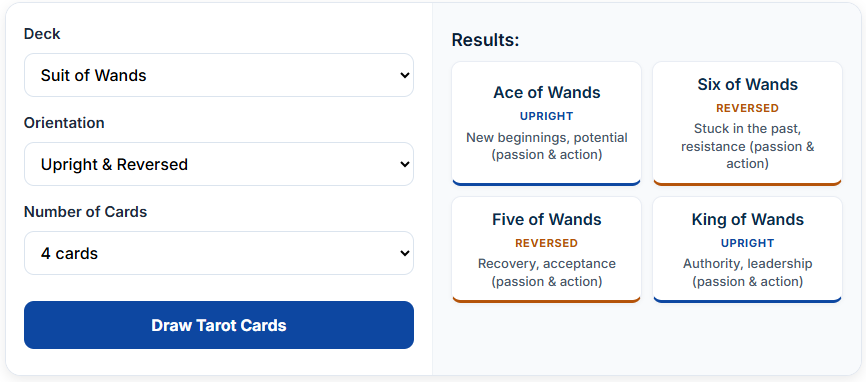
Use this Random Tarot Card Generator to draw tarot cards online and explore their symbolism, orientation, and possible interpretations. Choose a deck, select whether cards should appear upright or reversed, set the number of cards, and click the draw button to receive a random selection.
A random tarot card draw can be a useful starting point for personal reflection, learning tarot card meanings, exploring card symbolism, or finding a prompt for journaling. You can draw a single card for a quick insight or select multiple cards to create your own simple reading.
What Is a Random Tarot Card Generator?
A Random Tarot Card Generator is an online tool that selects tarot cards from a deck without requiring you to shuffle and draw physical cards. It gives you a convenient way to explore tarot cards online, discover unfamiliar cards, and practise interpreting their traditional symbolism.
A standard modern tarot deck commonly contains 78 cards, divided into two main groups:
- Major Arcana: 22 cards representing major themes, archetypes, transitions, and significant life experiences.
- Minor Arcana: 56 cards divided into four suits: Wands, Cups, Swords, and Pentacles.
Each group offers a different way to explore ideas and experiences. Major Arcana cards are often associated with broader life themes, while Minor Arcana cards are commonly used to consider everyday situations, relationships, thoughts, and practical matters.
The generator makes it easier to explore these cards through a quick random tarot card pull.
How to Use the Random Tarot Card Generator
The tool has three selection fields and a draw button. Follow these steps to use it:
- Choose a Deck: Select an available tarot deck from the Deck dropdown.
- Select Orientation: Use the Orientation dropdown to choose the card orientation available in the tool.
- Choose the Number of Cards: Set how many cards you want to draw using Number of Cards.
- Draw Your Cards: Click Draw Tarot Cards to generate your selection.
- Review the Results: Explore the cards displayed in the Results area.
You can use the generator again whenever you want another selection. The exact deck and orientation choices depend on the options currently available in the tool.
Understanding the 78 Tarot Cards
People searching for random tarot card 78, tarot card names, or a tarot cards meaning list with pictures are often trying to understand how a complete tarot deck is organized.
A traditional 78-card structure contains 22 Major Arcana cards and 56 Minor Arcana cards.
Major Arcana: 22 Cards
The Major Arcana contains symbolic cards that are often associated with important themes, personal development, challenges, and turning points.
The commonly recognized card names include:
- The Fool
- The Magician
- The High Priestess
- The Empress
- The Emperor
- The Hierophant
- The Lovers
- The Chariot
- Strength
- The Hermit
- Wheel of Fortune
- Justice
- The Hanged Man
- Death
- Temperance
- The Devil
- The Tower
- The Star
- The Moon
- The Sun
- Judgement
- The World
The meanings of these cards can vary between tarot traditions and interpretations. For example, The Fool is commonly associated with beginnings, openness, and taking a new step, while The Hermit is often connected with introspection and seeking understanding.
Minor Arcana: 56 Cards
The Minor Arcana is divided into four suits, each containing 14 cards.
Suit | Common themes |
Wands | Creativity, ambition, energy, and action |
Cups | Emotions, relationships, intuition, and connection |
Swords | Thoughts, communication, decisions, and conflict |
Pentacles | Work, resources, money, and practical matters |
Each suit traditionally contains Ace through Ten, followed by four court cards: Page, Knight, Queen, and King.
Together, these cards provide a broad symbolic vocabulary for exploring everyday situations and personal questions.
Upright and Reversed Tarot Cards
One important part of tarot interpretation is the difference between an upright tarot card and a reversed tarot card.
An upright card appears in its normal orientation. A reversed card appears upside down. Some tarot readers interpret the reversal as a different expression of the card’s themes, while others use different reading traditions.
A reversed card does not automatically mean something negative. Depending on the reader’s approach and the surrounding cards, it may suggest:
- An internal or private experience
- A delay or obstacle
- A theme that needs more attention
- An imbalance or difficulty
- A different perspective on the card’s usual meaning
For example, The Sun is often associated with clarity, optimism, and confidence. A reversed interpretation might invite reflection on temporary uncertainty, reduced confidence, or difficulty recognizing a positive situation.
If you want to explore random tarot cards with reversals, use the Orientation dropdown and select an available option that includes reversed cards. The tool’s exact orientation choices should be checked in the live dropdown.
How to Interpret a Random Tarot Card
A random card does not have to provide a fixed answer. You can use it as a prompt to think about a question, situation, or feeling.
Try this simple approach:
- Notice the card name: Identify the card you have drawn.
- Observe its imagery: Look at the people, objects, colours, and symbols shown.
- Check its orientation: Consider whether it is upright or reversed.
- Explore its traditional themes: Look up the card’s common interpretations.
- Connect it with your question: Think about how those themes relate to your situation.
- Reflect rather than assume: Treat the interpretation as a perspective, not a guaranteed prediction.
For additional learning, Learn Tarot’s card descriptions explain how card keywords, descriptions, and reversed interpretations can be approached.
Random Tarot Card Pulls and Simple Spreads
A random tarot card pull can involve one card or several cards. The number of cards you draw can change how you approach your reflection.
One-Card Tarot Pull
A one-card pull is a simple way to explore one theme or question. It can be used as a daily reflection prompt or as a way to learn the meaning of an unfamiliar card.
Example question: “What should I pay attention to today?”
Draw one card, examine its imagery, and write down a few thoughts about how its themes might relate to your day.
Three-Card Tarot Spread
A three-card tarot spread is a popular beginner-friendly format. A reader may assign a different role to each card.
For example:
- Card 1: Past or background
- Card 2: Present situation
- Card 3: Possible direction or advice
You can use the generator to draw multiple cards and then interpret them using a spread structure you choose. The tool provides card selection; it does not establish a specific spread position system unless that functionality is shown separately.
Creating Your Own Random Tarot Spread
You can also create a simple spread around a topic that matters to you.
For example, a personal reflection spread might use these prompts:
- What am I focusing on?
- What might I be overlooking?
- What could I explore next?
Choose the number of cards that fits your intended exercise, draw them, and assign each card one of your prompts.
Can Tarot Cards Answer Yes-or-No Questions?
People often search for tarot cards yes or no because they want a quick response to a specific question. Some tarot readers use simplified yes-or-no systems, assigning positive, negative, or uncertain interpretations to individual cards.
However, there is no single universal yes-or-no system followed by every tarot tradition. A card’s interpretation can depend on the deck, reading method, question, and surrounding cards.
You can use a random card as a reflection prompt for a yes-or-no question, but this generator should not be described as a dedicated yes-or-no tarot calculator. Its verified controls are for deck, orientation, and number of cards.
For a simple random yes-or-no choice, you can also try the Random Yes or No Generator. For broader choices, the Random Decision Maker offers a separate way to explore random decisions.
Tarot Card Meanings: How to Learn the Cards
Learning all tarot card meanings takes practice. Instead of memorizing dozens of keywords at once, start with the broad structure of the deck.
Here are some practical ways to learn:
- Begin with the 22 Major Arcana cards.
- Learn the four Minor Arcana suits and their general themes.
- Study one card at a time.
- Compare upright and reversed interpretations.
- Pay attention to the card’s visual symbols.
- Keep a journal of cards you draw and the ideas they bring to mind.
The Metropolitan Museum of Art’s introduction to tarot history and structure is useful for understanding the historical development of tarot cards and the structure of early decks.
You can also explore the Met’s tarot collection and related reading to see how tarot decks have been treated as historical and artistic objects.
Random Tarot Generator: What It Can and Cannot Do
The Random Tarot Card Generator is designed for drawing cards through a simple online interface.
What the live tool provides:
- A Deck selection dropdown
- An Orientation selection dropdown
- A Number of Cards dropdown
- A Draw Tarot Cards button
- A Results area for the selected cards
What should not be assumed:
- A complete written interpretation for every card
- A dedicated yes-or-no reading mode
- Pre-built past-present-future or relationship spreads
- A downloadable tarot cards PDF
- A separate gallery containing pictures and meanings for all 78 cards
These are different features from drawing random cards. If you need detailed explanations, use a dedicated tarot learning reference alongside the generator.
Creative Ways to Use a Random Tarot Card Picker
A random tarot card picker can be useful beyond a traditional reading. Try these activities:
- Daily journaling: Draw a card and write about the theme it brings to mind.
- Tarot learning: Draw unfamiliar cards and practise identifying their suits and symbolism.
- Creative writing: Use a card’s imagery as inspiration for a character, scene, or story.
- Art prompts: Explore the colours and symbols of a card before creating your own artwork.
- Group discussions: Let each participant draw a card and share a personal interpretation.
- Mindful reflection: Use a card as a prompt to consider your priorities or current feelings.
If you enjoy creative prompts, you can also explore the Random Topics Generator or use the Random Questions Generator to find discussion prompts.
For other light learning activities, try Random Facts and Random Trivia Questions.
You can also explore the Random Bible Verse Generator for a separate scripture-based reflection activity. Tarot and scripture are different traditions, so these tools serve different purposes.
Frequently Asked Questions
1. What is a random tarot card generator?
A random tarot card generator is an online tool that selects tarot cards for you. It provides a convenient way to draw cards without a physical deck, explore card names, and practise interpreting tarot symbolism.
2. Can I draw a random tarot card online for free?
You can use the Random Tarot Card Generator on this page to select a deck, choose an orientation, set the number of cards, and click Draw Tarot Cards. The available controls are displayed directly in the generator.
3. How many cards are in a standard tarot deck?
A standard modern tarot deck usually contains 78 cards: 22 Major Arcana cards and 56 Minor Arcana cards. The Minor Arcana is divided into Wands, Cups, Swords, and Pentacles.
4. What is the difference between upright and reversed tarot cards?
An upright card appears in its normal position, while a reversed card appears upside down. Some readers interpret reversed cards as blocked, internalized, delayed, or differently expressed themes. Interpretations vary between reading traditions.
5. Can I use a random tarot card for a yes-or-no question?
You can use a card as a reflection prompt for a yes-or-no question. However, tarot does not have one universal yes-or-no interpretation system, and this generator does not provide a dedicated yes-or-no mode among its verified controls.
6. What is the difference between a tarot card pull and a tarot spread?
A tarot card pull is the act of drawing one or more cards. A tarot spread is a structure that assigns a particular meaning or question to each card position, such as past, present, and future.
7. Can I generate a three-card tarot reading?
You can select multiple cards using the Number of Cards dropdown. To create a three-card reading, choose three if that option is available, draw the cards, and assign your own spread positions for interpretation.
Start Drawing Random Tarot Cards
Explore tarot symbolism one card at a time with the Random Tarot Card Generator. Select your deck and orientation, choose how many cards you want, and click Draw Tarot Cards.
Use each selection as an opportunity to learn card names, understand traditional meanings, and explore new ideas through reflection and creativity.