
Random Snake Generator – Explore Different Snake Species
Discover the fascinating world of snakes with our Random Snake Generator. This tool is designed for people who want to explore random snakes, learn about reptile diversity, or find interesting snake examples for educational and creative activities. It offers a simple starting point for discovering the many forms, colors, and characteristics found across the snake world.
From small burrowing snakes to large pythons and aquatic species, snakes live in a wide range of environments. Exploring different snake species can help students, teachers, wildlife enthusiasts, and curious learners understand how diverse these reptiles are.
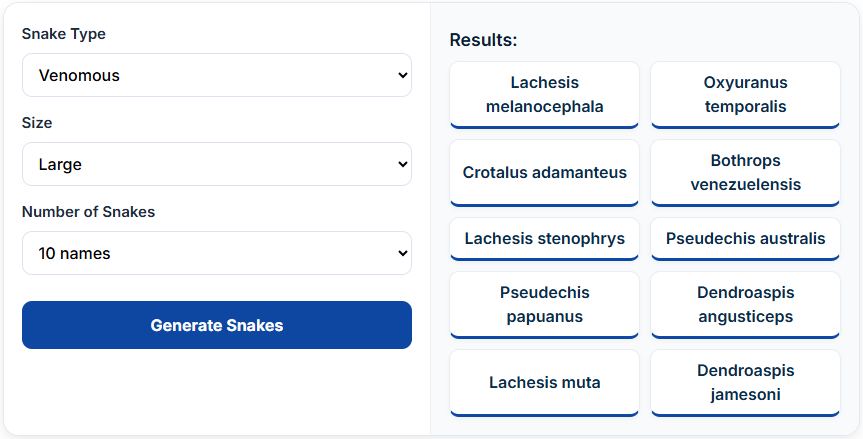
What Is a Random Snake Generator?
A Random Snake Generator is an online discovery tool for exploring snakes through random selection. Instead of choosing a familiar species every time, visitors can use a random result to encounter a different snake and learn more about the variety of reptiles found around the world.
It can be useful for:
- Discovering unfamiliar snake species.
- Creating wildlife quizzes and classroom activities.
- Finding examples for educational presentations.
- Getting inspiration for stories, games, and creative projects.
- Exploring reptile diversity without manually browsing long species lists.
If you want to explore animals beyond snakes, you can also visit our Random Animal Generator to discover other animal groups.
Explore the Diversity of Snake Species
Snakes belong to the reptile group and are found in many different habitats. Their body shapes, colors, patterns, behaviors, and sizes vary considerably between species.
Here are some well-known types of snakes you may encounter while learning about reptiles.
Pythons
Pythons are non-venomous constrictor snakes found in parts of Africa, Asia, and Australia. They capture prey using their bodies and are known for their muscular build. Some species, such as the reticulated python, can grow to impressive lengths.
Cobras
Cobras are recognizable for the hood some species display when threatened. They belong to a group of venomous snakes and are found in parts of Africa and Asia. Their distinctive appearance makes them a familiar subject in wildlife education.
Vipers
Vipers are a group of venomous snakes with specialized fangs. Many species have broad heads and patterned bodies, although appearance differs across the group. They occupy a variety of habitats, including forests, grasslands, and deserts.
Boa Constrictors
Boa constrictors are non-venomous snakes that subdue prey by constriction. They are generally associated with Central and South American habitats and are known for their strong bodies and varied patterns.
Sea Snakes
Sea snakes are adapted to life in marine environments. Many have flattened, paddle-like tails that help them move through water. They are a useful example of how different snake species adapt to their surroundings.
Where Do Snakes Live?
Snakes occupy a wide range of environments. Depending on the species, they may live on land, in trees, underground, or in water.
Common snake habitats include:
- Forests: Many snakes use vegetation, fallen logs, and sheltered areas for protection.
- Deserts: Some species are adapted to dry environments and may avoid extreme daytime heat.
- Grasslands: Open habitats provide opportunities for hunting and shelter.
- Wetlands: Water-associated snakes may live near rivers, ponds, and marshes.
- Oceans: Sea snakes spend much of their lives in marine environments.
- Underground spaces: Some smaller species spend much of their time beneath the surface.
The San Diego Zoo’s snake overview provides additional information about snake habitats, diets, movement, and physical adaptations.
How to Learn From Random Snake Results
A random selection can be more useful when you turn each result into a small learning activity. Try these ideas:
- Identify the snake: Write down the name of the snake shown by the result, if a species name is provided.
- Research its habitat: Find out which regions or environments the species naturally occupies.
- Observe its appearance: Notice its body shape, colors, markings, and other visible characteristics.
- Explore its behavior: Learn how it moves, finds food, and responds to its environment.
- Compare another result: Generate or explore another snake and identify similarities and differences.
For more detailed educational information, the Texas Parks and Wildlife Department’s Snake FAQ explains snake characteristics, habitats, behavior, and diversity.
Interesting Facts About Snakes
Snakes have several unusual features that make them interesting to study.
- Snakes do not have external legs, and their long bodies contain many vertebrae.
- They periodically shed their outer skin as they grow.
- Their forked tongues help collect scent particles from the environment.
- Different species use different methods of movement, including swimming, climbing, and sidewinding.
- Some snakes lay eggs, while others give birth to live young.
- Their diets vary by species and can include insects, fish, amphibians, birds, and mammals.
These differences make snakes an interesting group to explore through wildlife learning activities.
Venomous and Non-Venomous Snakes
One important part of learning about snakes is understanding the difference between venomous and non-venomous species. Venomous snakes use specialized structures to inject venom, while non-venomous snakes do not use venom in this way.
However, identifying a snake from its color or appearance alone can be unreliable. Patterns and physical characteristics vary, and some species can look similar. Never approach, handle, or attempt to identify an unfamiliar wild snake at close range. Keep a safe distance and contact a qualified local wildlife professional when identification is necessary.
Who Can Use a Random Snake Generator?
The random snake generator can be a useful starting point for different activities:
- Students: Explore reptile examples for school projects and assignments.
- Teachers: Use random selections to create classroom questions and wildlife-learning activities.
- Wildlife enthusiasts: Discover snake species they may not have encountered before.
- Writers and creators: Find animal inspiration for fictional worlds, stories, and creative projects.
- Quiz makers: Build simple questions about snake names, habitats, and characteristics.
If you are interested in other animal groups, explore our Random Bird Generator and Random Fish Generator.
Explore More Animal Generators
Snakes are only one part of the animal world. You can explore other animal-related tools on RandomNamePick:
- Discover different wildlife with the Random Animal Generator.
- Explore aquatic species with the Random Fish Generator.
- Discover bird varieties using the Random Bird Generator.
- Find naming inspiration with the Random Pet Name Generator.
- Explore names for dogs with the Random Dog Name Generator.
- Find ideas for cats with the Random Cat Name Generator.
Frequently Asked Questions
What is a Random Snake Generator?
A Random Snake Generator is an online tool for discovering snakes through random selection. It can help users explore snake examples and find starting points for learning about different reptile species.
Why use a random snake generator?
It can make wildlife exploration more engaging by introducing users to snakes they might not think to search for themselves. It can also provide inspiration for quizzes, classroom activities, and creative projects.
What are some common types of snakes?
Some well-known groups and examples include pythons, cobras, vipers, boas, and sea snakes. These snakes differ in their physical characteristics, habitats, behavior, and adaptations.
Where do snakes live?
Snakes live in many environments, including forests, deserts, grasslands, wetlands, underground spaces, and oceans. Their habitat depends on the adaptations and needs of each species.
Are all snakes venomous?
No. Snakes include both venomous and non-venomous species. Their characteristics vary, and an unfamiliar snake should never be approached or handled to determine whether it is dangerous.
Can a random snake generator help with school projects?
Yes. A random selection can provide a starting point for researching a snake’s habitat, appearance, behavior, and ecological role. Students should use reliable educational or wildlife sources to check information.
How can I identify a snake safely?
Do not approach or handle an unfamiliar snake. Identification should be based on reliable regional references or advice from a qualified wildlife professional. A random generator is for exploration, not real-world snake identification.
Discover More About Snakes
Snakes are a diverse group of reptiles with different appearances, habitats, and adaptations. Use the Random Snake Generator as a starting point for exploring this diversity, then learn more about any interesting result through trusted wildlife and educational resources.